
When we talk about slippery floors, the bathroom may be the first area that comes to mind. In fact, many other areas of the home are also often exposed to water without us realizing it.
A terrace after rain, wet feet after leaving the pool, or the connecting area between the garden and the inside of the house. In situations like these, a floor that felt comfortable can become more slippery when wet.
Especially if there are active children or older family members at home, choosing floor materials for these areas becomes even more important. So, which areas need attention?
5 Areas Around the Home That Get Slippery When Wet
1. A Terrace Often Exposed to Rain
The terrace is one of the areas of a house most easily affected by weather changes. When it rains, water can be carried into areas that residents use often. That is why, besides choosing a look that suits the façade or the concept of the house, the character of the floor surface also needs attention.
Materials with better grip when wet can help make coming and going from the house feel safer.
2. The Area Around the Swimming Pool
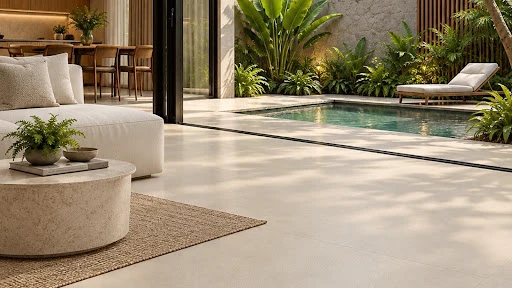
Getting out of the pool with wet feet and walking to a chair or into the house is a common activity. But because it is constantly exposed to water, the area around the pool needs extra attention when choosing the floor.
It is not only about a look that blends with the outdoor design, but also about how the surface provides better grip when wet.
3. The Balcony
Balconies sometimes go unnoticed because they are not always large. Yet semi-outdoor and outdoor balconies can be hit by rain. This means material choices should not be based only on motif and color.
Balconies also have relatively limited space to move, so the comfort of every step still needs attention.
4. Gardens and Outdoor Walkways
The path from the garden to the house is also an area that often meets water, whether from rain or from watering plants. If this area is a route residents use regularly, choosing a floor with suitable grip can help create more comfortable access. And of course, safer does not have to mean it looks like a utility area.
5. The Transition Area from Outdoor to Indoor
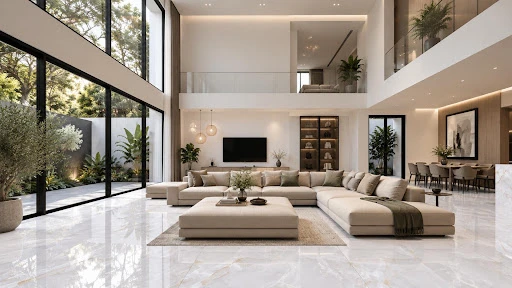
This is one of the areas that is often overlooked. After walking in from the garden, terrace, or pool area, water can be carried by footwear several steps into the house. As a result, a transition area that looks dry can become wet at any time. That is why, when designing a home with an indoor-outdoor concept, the choice of floor in the connecting area also needs to be considered.
Titanium STEP SAFE*: Smooth to the Touch, Grippier When Wet
Floors with better grip are often associated with rough surfaces. In fact, comfort and safety do not have to come at the cost of how a space looks.
Titanium STEP SAFE* comes with the R12 standard, with a surface that stays smooth and comfortable to the touch but becomes grippier when it meets water to help reduce the risk of slipping.
The big slab format of 120×240 cm also means fewer joints, so indoor and outdoor areas can still look wide, neat, and seamless. In other words, the need for better grip can go hand in hand with a premium home design.
Designed for Many Areas of the Home
Titanium STEP SAFE* can be used for many areas that are often exposed to water, from bathrooms, areas around swimming pools, terraces, balconies, and gardens, to indoor-outdoor transition areas.
Titanium Sintered Stone is produced in Indonesia by PT Surya Multi Cemerlang, part of Platinum Ceramics Group, which has 55 years of experience in Indonesia’s tile industry and is Halal certified.
With a wide range of motifs, Titanium STEP SAFE* gives you the flexibility to match your flooring needs to your home design concept without compromising its look. Have an area at home that often gets wet? Explore the Titanium STEP SAFE* motif options and find the one that suits your space.
*Titanium STEP SAFE helps reduce the risk of slipping with a special material that activates when in contact with water, in line with Pendulum Test Value (PTV) results at R12 (P4).